Let’s start August’s contribution to the Way Home Project with a little controversy.
Who was the greatest Doctor Who?
For me, it has to be David Tennant, hands down, with an honourable mention to Tom Baker and his Jelly Babies. I know opinions on this topic can regenerate faster than the Doctor himself, so let’s see if this causes a ripple through the Whovian universe.
There is a reason I wanted to make that big blue ball go all wiggly wobbly, timey wimey.
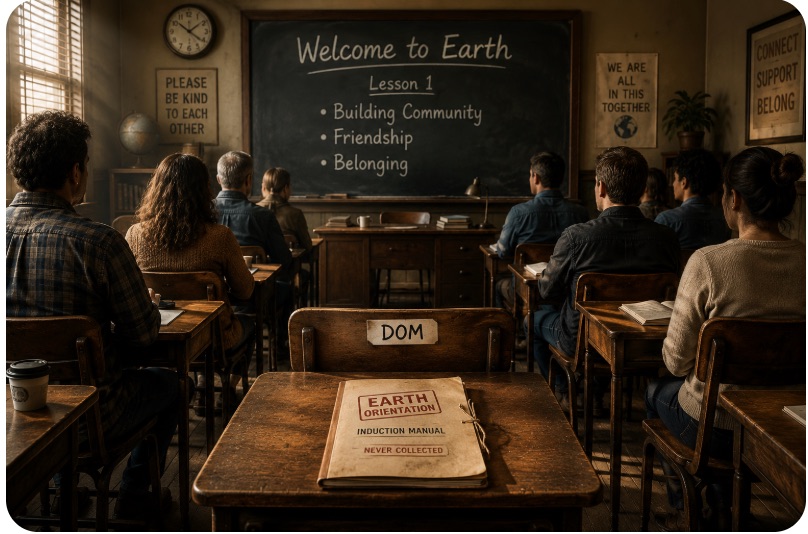
In the 2007 Doctor Who Christmas special, Voyage of the Damned—the one featuring Kylie Minogue—there is a scene that has stayed with me for years. Before the passengers travel to Earth, they all attend an induction class to learn about human life, customs and etiquette.
Lately I’ve come to the conclusion that I must have missed my induction class.
Not the one about gravity or breathing—that part seems to be working reasonably well—but the one about staying connected to community and making friends. At 52 years of age, it still feels like a mystery to me.
So, naturally, I turned to Siri.
I asked, “What is the definition of friendship?”
This was the response:
Friendship: the emotions or conduct of friends; the state of being friends. A relationship between friends. A state of mutual trust and support.
I politely explained that this was spectacularly unhelpful.
Siri informed me I was being disrespectful and ignored me for the rest of the evening.
Many of you may be wondering why something as simple as friendship has become such a significant topic for me. The answer is that the past few years have changed the way I see how human connection actually works.
For many people, society provides invisible laneways that naturally bring us into contact with others.
As children, we attend school and friendships begin to form almost without effort. Then comes high school, university, apprenticeships or the workforce. Some people join sporting clubs, churches or community groups. Others become parents and suddenly find themselves surrounded by other parents. Workplaces create teams. Neighbours become familiar faces. Communities quietly grow around us.
Most of us rarely stop to notice these structures because they’ve always been there.
But what happens when life suddenly removes almost all of them within six to twelve months?
When my wife passed away, our marriage disappeared overnight. So did the daily rhythm of hospitals, specialists, nurses, medical suppliers and the countless people who had become part of our world during her illness.
When I experienced burnout, the workplace connections that remained also disappeared.
Then one day I looked around my home and realised something else had quietly happened. For almost fifteen years, my house had represented everything at once. It had been a family home, a hospital ward, an emergency room and, eventually, a corporate office.
No wonder it had become so difficult to understand where life ended and survival began.
At times it felt a little like Cooper in Interstellar, floating in the darkness of the black hole, looking back at the world, desperately trying to communicate with it.
The advice I received was the advice many of us have heard before.
“Join a club.”
“Find a hobby.”
“Go back to the gym.”
“Play tennis again.”
“Get out there and meet people.”
Then come the wonderful community campaigns encouraging us to call a friend, check on a mate or ask someone if they’re okay.
These are all well-intentioned ideas, but I discovered they quietly rely on two assumptions.
The first is that we already have a network to reconnect with.
The second is that we have the emotional capacity to build new relationships while our world is still trying to find solid ground.
Over the last decade, I’ve also noticed two changes that rarely seem to be discussed.
The first is capacity.
Twenty years ago, joining a sporting club or community group often meant spending time together before or after the activity. Conversations lingered. Coffee happened naturally. Friendships had room to grow.
Today, many of us seem to be running from one commitment to the next. The activity itself has become the reason people gather, and when the activity stops, the connection often stops with it.
Dad unintentionally illustrated this during his last visit. At eighty years of age, he told me he was considering meniscus surgery so he could continue running.
It wasn’t really about running.
Running was the bridge that connected him to his community.
If he stopped running, he feared he would slowly lose many of the friendships that had formed around it.
That conversation stayed with me.
The second observation is something I’ve been quietly wrestling with for some time.
I wonder whether we’ve placed too much weight on too few structures.
Perhaps we’ve unknowingly expected our friendships to carry loads that were once shared across families, neighbourhoods, workplaces, churches, clubs and communities.
When one of those structures disappears today, there often aren’t enough others remaining to distribute the weight.
Engineers call it load distribution.
Life might call it belonging.
I’m not sure I’ve found the answer yet.
But I do know this.
Perhaps the question isn’t simply, “How do we make more friends?”
Perhaps it’s, “How do we build lives where connection isn’t dependent on a single place, a single activity or a single relationship?”
Maybe that’s the induction class I missed.
And maybe I’m not the only one.


