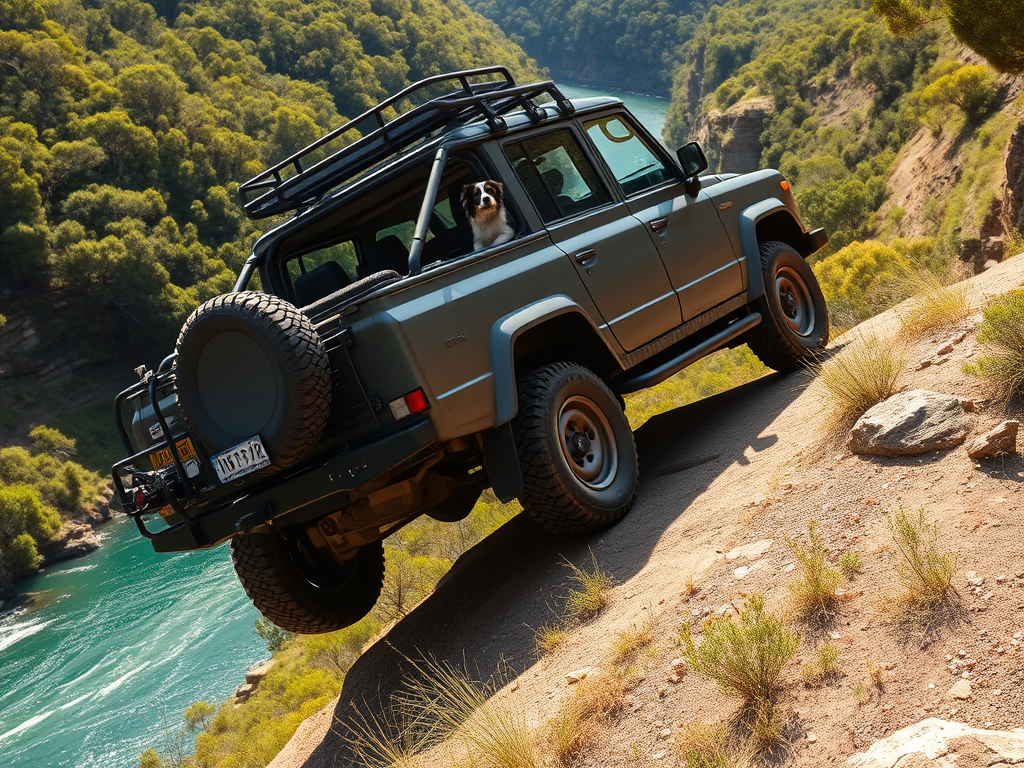
The look on my two Border Collies faces, Loki and Lucy, said it all:
“WTF, Dad?”
Let me take you back about ten minutes earlier.
I was exploring The Gorge in northern NSW near Grafton, parked at the top of the campground, when I spotted what looked like a promising side track — something that might take me closer to the waterfalls feeding the Clarence River. It was a little overgrown, sure, but I figured I could handle it.
What I didn’t realise until it was far too late… was that I wasn’t on a track at all. I was following two cow paths. Parallel, deceiving, and utterly inappropriate for a vehicle the size of my MU-X.
A few tense metres later, the car was perched on a 45-degree bank angle, teetering dangerously close to the river’s edge.
Loki and Lucy had been sleeping peacefully in the back. That is, until the sudden lurch. Loki barrel-rolled across the back seat, almost flattening Lucy in the process. His weight, combined with the vehicle’s lean, made things worse — and for a moment, I genuinely thought we were going over.
So I did what any calm, rational off-roader would do:
I climbed out… and sat on the side step like a human counterweight.
And I waited.
An hour, to be exact — until a nearby station hand arrived to winch me out of trouble.
Plenty of time to think.
Plenty of time to feel sheepish.
Plenty of time to notice two very unimpressed Border Collies in the back.
But in that unexpected pause, something shifted.
Because while I sat on that sidestep, trying not to breathe too heavily and reflecting on the chain of decisions that led me here, I finally had clarity on something else:
The Recovery Points Conundrum.
🔩 The Vehicle Problem
My MU-X came fitted with a factory bull bar. Looks great. Sturdy enough. But here’s the kicker: Isuzu, in their wisdom, designed it so that rated recovery points couldn’t be fitted.
So for the past year, I’d been stuck in this decision spiral:
- Do I rip off the perfectly good bull bar and spend $5,000 installing a new one just to add rated recovery points and a winch?
- Or do I risk continuing my adventures without the right gear, hoping for the best?
What started as a $500 upgrade had turned into a $5,000 existential crisis — all because the gear didn’t match the journey anymore.
And in that moment — stuck, humbled, and held in place only by physics and dumb luck — I knew:
You don’t compromise on recovery.
Not in vehicles.
Not in life.
🧰 What Belongs in Your Recovery Toolkit
That day forced me to reflect not just on my 4WD setup…
But on the human recovery points I’d needed through my carer journey.
So here’s what I now believe should be standard issue — not just for off-roading, but for anyone navigating long-haul care, grief, healing, or rebuilding:
🏥 1. A Consistent General Medical Practice
Gone are the days of one family doctor for life. But consistency still matters.
Find a GP clinic that knows your history, respects your story, and won’t make you retell your trauma every visit.
This becomes your baseline record keeper — your map of the wear and tear you’ve endured.
🧠 2. A Therapist (Like You’d Choose a Mechanic)
When I left home, my Dad said:
“Dom, make sure you know a reliable plumber, electrician, and handyman.”
Great advice. But you know what I wish he’d added?
“And find yourself a bloody good therapist.”
A therapist who’s in your corner — no agendas, no judgement — is one of the best recovery tools you’ll ever invest in.
But here’s the key: consistency.
Stick with one long enough that they know the terrain of your story better than you do.
🛡️ 3. An Income Protection Policy
Here’s the uncomfortable truth:
The carer journey will take a toll on your health — physical, mental, emotional.
And when it ends (because it always does), your body and mind will collapse in ways you didn’t expect.
An income protection policy, linked with your GP and therapist, becomes your financial recovery point.
It buys you space to heal.
🐾 4. An Active Dog Breed
Sounds random? Stay with me.
I got Loki at the apex of my wife’s illness — not because I needed a pet, but because I needed a vice-free companion.
Something that forced me out of the house without guilt. Someone who didn’t ask questions, just stayed beside me.
Loki was my anchor. Lucy joined later, forming a team that still knows when I’m spiralling before I do.
A loyal dog won’t fix your life — but they’ll stand next to you while you pick up the pieces.
⌚ 5. An Apple Watch (or Something Like It)
In the later years, when I couldn’t do anything for myself — not sleep, not cook, not even feel — I could still close my three Apple Watch rings.
- Stand every hour in the Emergency Room
- Burn calories carrying dialysis boxes.
- Walk the farthest car park just to take the stairs to her hospital room.
Every time I closed my rings, I got a little firework show.
And for 1,458 consecutive days, I had something that said:
“Yes, today was hell. But you still did something for you.”
Those little victories mattered more than I can explain.
They kept me in the fight — quietly, stubbornly, beautifully.
🌱 Why I’m Sharing This
Because I promised myself I wouldn’t tell others how to live or heal.
But I will share what helped me survive.
And maybe, somewhere in here, you’ll find a tool, a truth, or a moment that resonates with your own path.
Because recovery doesn’t just happen.
It’s not passive.
You don’t stumble into peace.
You build it.
One recovery point at a time.
One dog walk. One therapy session. One stand ring.
One moment where you decide not to keep driving toward the edge — but instead… to pause, assess, and gently back your way into safety.
🛻 This Isn’t the End of the Road — It’s Just a Wiser Way to Travel.
This story — this moment stuck on a hillside with two grumpy border collies, a tipping 4WD, and an hour to think — wasn’t a crisis.
It was a pivot.
The kind where the old wiring might still flare, but now there’s backup.
Where the lesson doesn’t cost you the car — just the illusion that you could keep pushing without consequence.
So maybe that’s what recovery really is:
Learning to drive your life differently.
With better tools.
With rated recovery points.
With companions who don’t ask you to explain, just sit quietly and wait with you — even when they’re giving you side-eye.
🚧 The Way Home Is Still Being Built
This reflection might mark the close of one arc — the recovery years, the survival days, the ache of collapse.
But this project?
It’s not finished.
Because I’m not finished.
There are still pages to write.
Meals to share.
Tracks to explore.
Truths to uncover.
And a peace to live from — not chase.
So I’ll keep writing.
Keep walking.
Keep building recovery points — not just in vehicles, but in conversations, kitchens, quiet mornings, and moments of presence.
And if you’re reading this, still wondering where your recovery starts?
It might be right here — with one honest inventory…
… and the courage to admit it’s time to install the recovery points you’ve been avoiding.
We don’t go back to who we were.
But we can learn to live forward — on our own terms.
One firework at a time.
— Dom 🐾🛠️🔥

 The Way Home Project