Tag: family

  • Why 2nd trumps 1st everytime

    Why 2nd trumps 1st everytime

    “Can’t make it today; in the hospital” was the text I received in late January 2026.

    It came from my best friend, a friendship spanning more than a quarter of a century. It wasn’t a complete surprise. My friend has been battling a chronic disease for a long time, so I took it in my stride. I went for a swim.

    About an hour later, a lengthy voicemail from a mutual friend appeared on my phone.

    I’ll spare you the details, but it turned out my friend was now on an operating table fighting for their life.

    Needless to say, that shook my world.

    The surgery was successful, and eight months later we are back to normal: me receiving a bucket load of black threes whenever we play Canasta and the two of us complaining about how Jack Bauer somehow never needs a toilet break during the 24 hours he spends saving the world.

    Then came another sentence.

    “I am retiring in six weeks.”

    That was how my psychologist of 15 years dropped that little bombshell on me.

    During those 15 years we tackled a possible future kidney donation, managing a decade-long carer role, being the end-of-life carer for my wife, and eventually the corporate burnout that fried my nervous system.

    My immediate response was, “So what does continuity of care look like?”

    “What do you mean?” came the reply.

    Well, that got the nervous system nicely supercharged.

    Then there was the 2026 World Cup final.

    Spain defeated Argentina 1–0 after extra time. I was still on a high from the utterly ridiculous England–France match the day before, but what stuck with me afterwards was watching Argentina deal with coming second in the world.

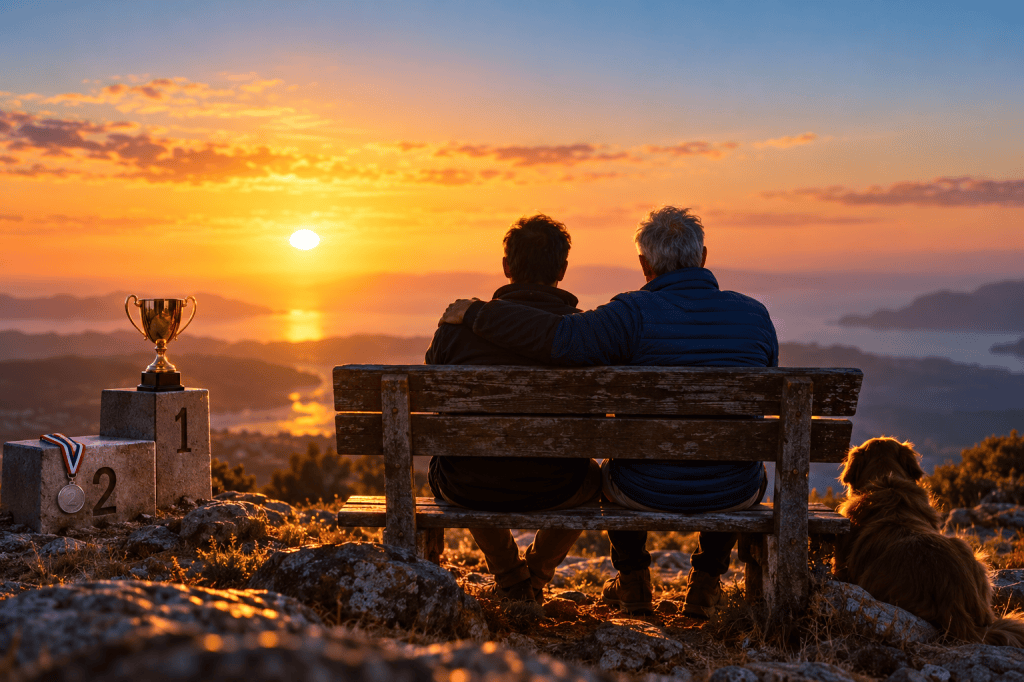
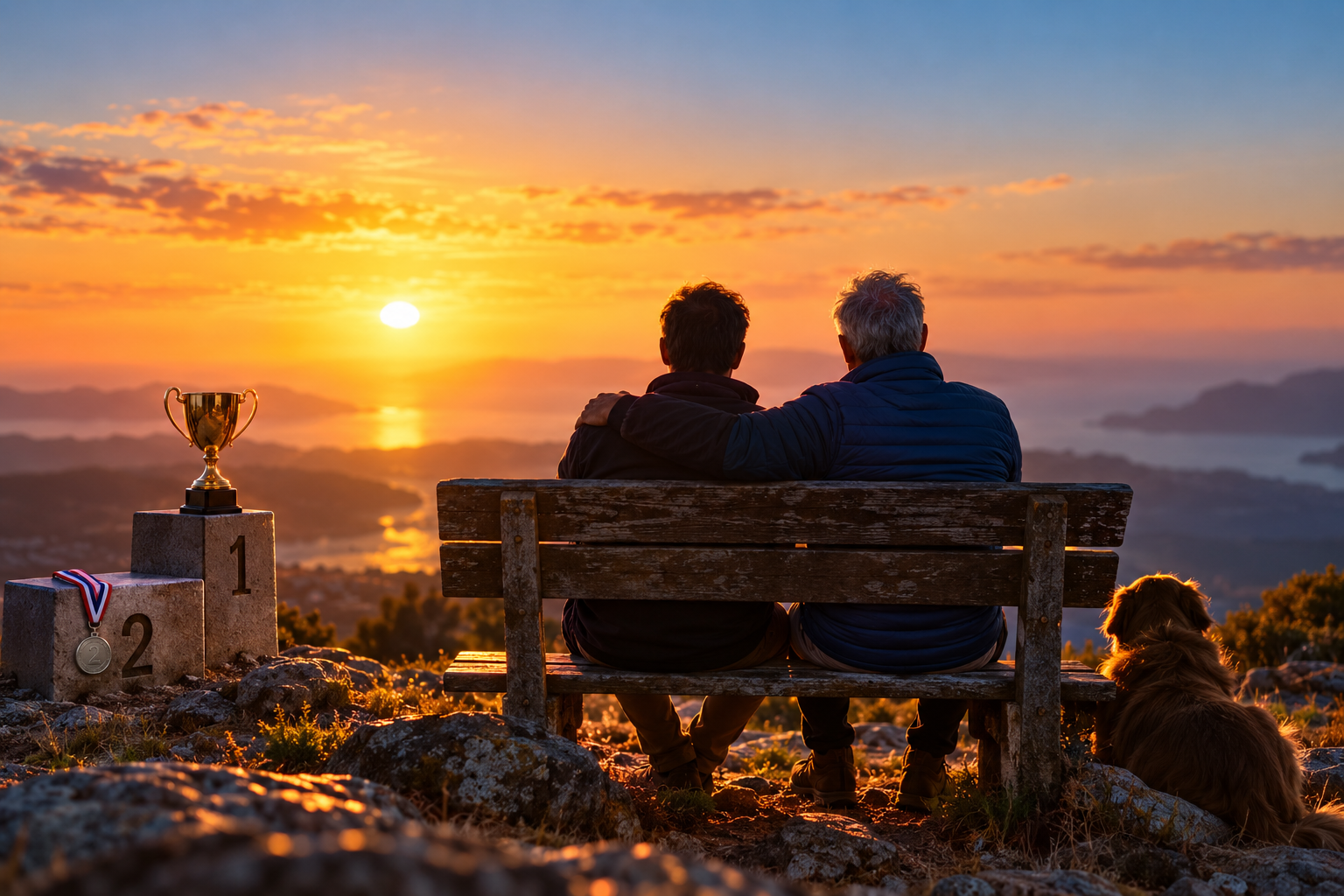
    Second.

    We use that word strangely.

    Ben Shelton: runner-up at the US Open.

    Aryna Sabalenka: runner-up at the US Open.

    Argentina: runner-up at the World Cup.

    All extraordinary achievements, yet almost immediately the conversation turns to what they didn’t do. The points they lost. The opportunities they missed. Why they weren’t first.

    Three completely unrelated events over six months got tangled together in my head and started me thinking:

    Why is being second not respected in the same way as being first?

    And, eventually, I came to a slightly ridiculous conclusion.

    I think being second might actually be more important.

    Stay with me before we start checking my medication dosages.

    Because I’m not really talking about silver medals.

    I’m talking about the person standing beside you.

    Second is the witness.

    And a witness provides something first place can never provide on its own: context.

    My best friend has been in my life for more than 25 years. My psychologist has been there for 15.

    Both had front-row seats to the hardest and most destructive decade of my life.

    They knew me before it.

    They saw me inside it.

    And, importantly, they can see me coming out the other side of it.

    That matters more than I realised.

    When your nervous system has spent years modifying itself around danger, grief, responsibility and survival, your own assessment of how you are travelling isn’t always the most reliable instrument in the cockpit.

    Some days I can look at my life and think I have failed spectacularly.

    I couldn’t save my wife.

    My corporate career ended in burnout.

    The version of life I thought I was supposed to have disappeared somewhere along the way.

    But then somebody who actually witnessed that journey says, “You’re doing well.”

    That lands differently.

    They aren’t reading the brochure.

    They saw the wreckage.

    They know what “doing well” is being measured against.

    That is the extraordinary value of second.

    First experiences the event.

    Second witnesses it.

    First knows how something felt from the inside.

    Second remembers what it looked like from the outside.

    And sometimes we need both versions before we can see the whole picture.

    I think that was partly why those two events unsettled me so much.

    When my friend was suddenly fighting for their life, I wasn’t only frightened of losing someone I loved. Somewhere underneath that fear was the possibility of losing one of the few people who remembers whole versions of me that no longer exist.

    And when my psychologist announced his retirement, something similar happened.

    Who holds that history now?

    Who remembers the man contemplating kidney donation? The carer? The husband sitting beside a dying wife? The corporate manager desperately trying to keep functioning while his nervous system was screaming that the aircraft was no longer airworthy?

    Who can look at the bloke wandering along the beach at sunrise with a coffee, playing disc golf twice a week, pottering around his garden, considering volunteering at an aviation museum and say:

    “I know where you came from.”

    That is witness.

    And perhaps that is also why our obsession with first place gets things so wrong.

    First place is usually individual.

    It asks: What did I achieve?

    Second introduces relationship.

    Who was beside me?

    Who saw it?

    Who challenged me?

    Who remembers?

    Who can remind me of the distance travelled when I temporarily forget?

    Maybe recovery isn’t about becoming number one.

    Maybe life isn’t either.

    Perhaps it is about collecting enough good people in the second chair that when your instruments start giving you questionable readings, someone who knows your flight history can quietly lean across and say:

    “No. Look again. You’re actually doing okay.”

    I still like winning.

    Let’s not get carried away.

    And I am reasonably confident my best friend will continue weaponising black threes against me at Canasta.

    But I think I understand second place differently now.

    The world celebrates the person holding the trophy.

    Increasingly, I’m grateful for the people standing beside them.

    Because first may get the photograph.

    But second often holds the story.

    And sometimes, when you’re trying to find your way home, the person who remembers your story is far more valuable than the person who finished first.
  • When Every Room Has a Job

    When Every Room Has a Job

    “Home is supposed to be where we leave work behind. But what happens when home becomes everything?”


    I’m going to date myself here.

    Does anyone remember the movie The Net starring Sandra Bullock?

    There’s a scene where she’s sitting on a beach, laptop balanced on her knees, becoming increasingly frustrated because she can’t get her dial-up connection to work while she’s on holiday.

    Yes… dial-up internet.

    I warned you I was going to show my age.

    Back then, the idea of working from anywhere seemed futuristic. Fast forward thirty years and working from home has become one of the most debated topics in modern workplaces.

    Whenever the conversation flares up, it usually follows a familiar script.

    Employers argue that productivity, collaboration and culture suffer.

    Employees argue that flexibility, autonomy and work-life balance have improved.

    Both sides make valid points.

    But there is one aspect of working from home that I rarely hear discussed.

    The long-term psychological impact of living, working and caring for others within the same four walls.


    I worked from home for more than a decade for one of the world’s largest technology companies.

    What began as a six-month contract eventually became a leadership role, managing a fully virtual team of more than 150 people.

    Working from home wasn’t simply a lifestyle choice.

    It became a lifeline.

    Around the same time, my wife Karina’s kidney disease was progressing. Removing a four-hour daily commute gave me back almost twenty hours every week and, more importantly, meant I could be close to the hospital if something went wrong.

    For the first few years it worked remarkably well.

    I had structure.

    I trained most mornings for upcoming triathlons.

    I had a dedicated office.

    I made sure I left the house every day.

    I still had routines that separated work from life.

    Looking back, that separation was doing far more heavy lifting than I realised.


    Everything changed in 2016.

    Karina was no longer eligible for a kidney transplant.

    After many difficult conversations, we made the decision for her to begin dialysis at home.

    We believed giving her greater control over her treatment would improve both her quality of life and her dignity.

    I still believe we made the best decision we could with the information we had.

    But it fundamentally changed our home.

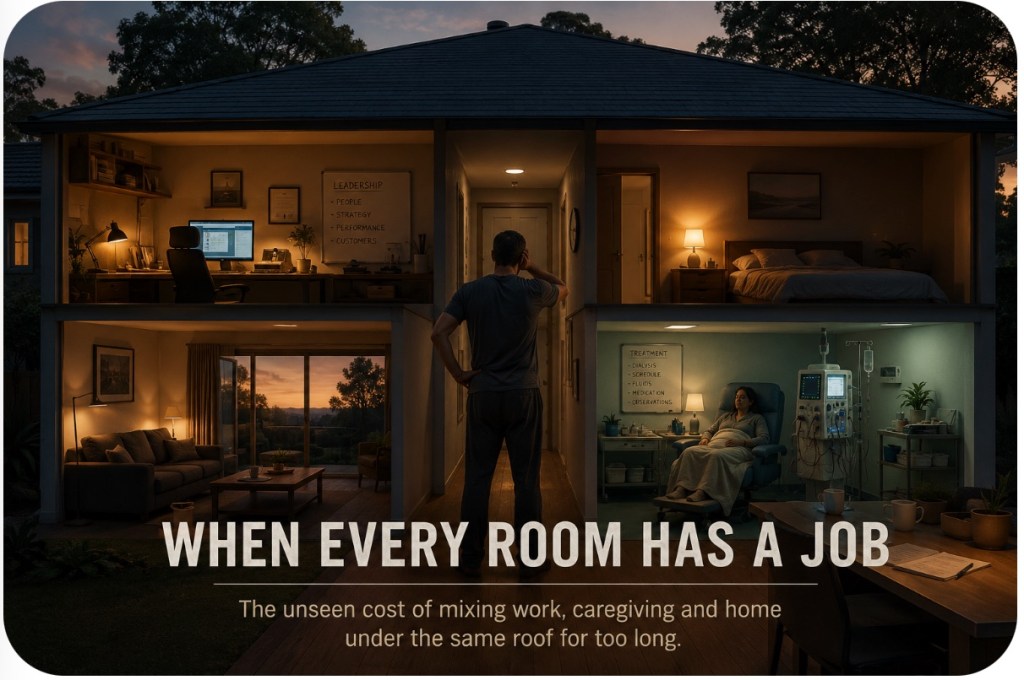
    Suddenly, every room had a job.

    Our house became my workplace.

    It became a hospital ward.

    It became the place where I was trying to hold a marriage together.

    The boundaries between those roles quietly disappeared.

    One of the memories that has never left me is hearing the “Calls Waiting” alarm from my work computer sounding at the same time as the alarm on Karina’s dialysis machine.

    Those two completely different worlds had begun operating in perfect synchronisation.


    Working from home also made some extraordinary things possible.

    I could continue working from a doctor’s waiting room while Karina was in surgery.

    I joined leadership meetings from hospital cafeterias.

    I answered emails while waiting for her to come out of recovery.

    My employer received the leadership they expected.

    Karina received the support she needed.

    In many ways, working from home made the impossible possible.

    I remain genuinely grateful for that flexibility.


    Looking back now, I don’t believe working from home harmed me.

    But I do think something else happened.

    Something much quieter.

    I slowly lost perspective.

    Not because I stopped working with people.

    But because I stopped living alongside them.


    One of the biggest things I lost wasn’t my office.

    It was everything around the office.

    The conversations walking to the car park.

    Chatting while making a coffee.

    Listening to someone talk about their holiday.

    Celebrating a promotion.

    Watching new employees find their confidence.

    Sharing a laugh after a difficult meeting.

    Those moments seem ordinary.

    But they’re constantly calibrating us.

    They remind us that our workplace isn’t the only workplace.

    That our manager isn’t every manager.

    That our experience isn’t everyone’s experience.

    Working from home slowly removed those reference points.

    Then caregiving removed almost everything that remained.

    Without noticing, my world became incredibly small.

    Today, one of my greatest vocational challenges isn’t capability.

    It’s perspective.

    I genuinely don’t know what a healthy workplace feels like anymore.

    When you’ve spent years with your home functioning simultaneously as your office, hospital and sanctuary, the idea of stepping back into another working environment becomes surprisingly difficult.

    Not because you’ve forgotten how to do the work.

    But because you’ve lost the ability to compare one environment with another.

    When every room has had a job, it’s hard to imagine what it feels like to simply walk into a workplace where your only responsibility is to do your job.


    I often wonder whether this is something we’ll understand better in another ten or twenty years.

    Perhaps working from home isn’t simply about productivity or flexibility.

    Perhaps it’s also about understanding the invisible role our environments play in shaping our wellbeing.

    For me, recovery hasn’t just been about healing from grief or burnout.

    It’s also been about slowly teaching my home that it no longer has to be everything.

    That some rooms can simply be places to read.

    To cook.

    To sit quietly.

    To laugh with friends.

    To watch the sunrise with two Border Collies asleep at my feet.

    Home is gradually becoming home again.

    And perhaps that’s been one of the most important parts of the journey.


    “I’d love to hear your thoughts. If you’ve worked from home for an extended period—especially while balancing caring responsibilities—did you notice changes that went beyond productivity? I’d be interested to know whether anyone else has experienced something similar.”